Project Management Software for EPC Companies: What to Look For
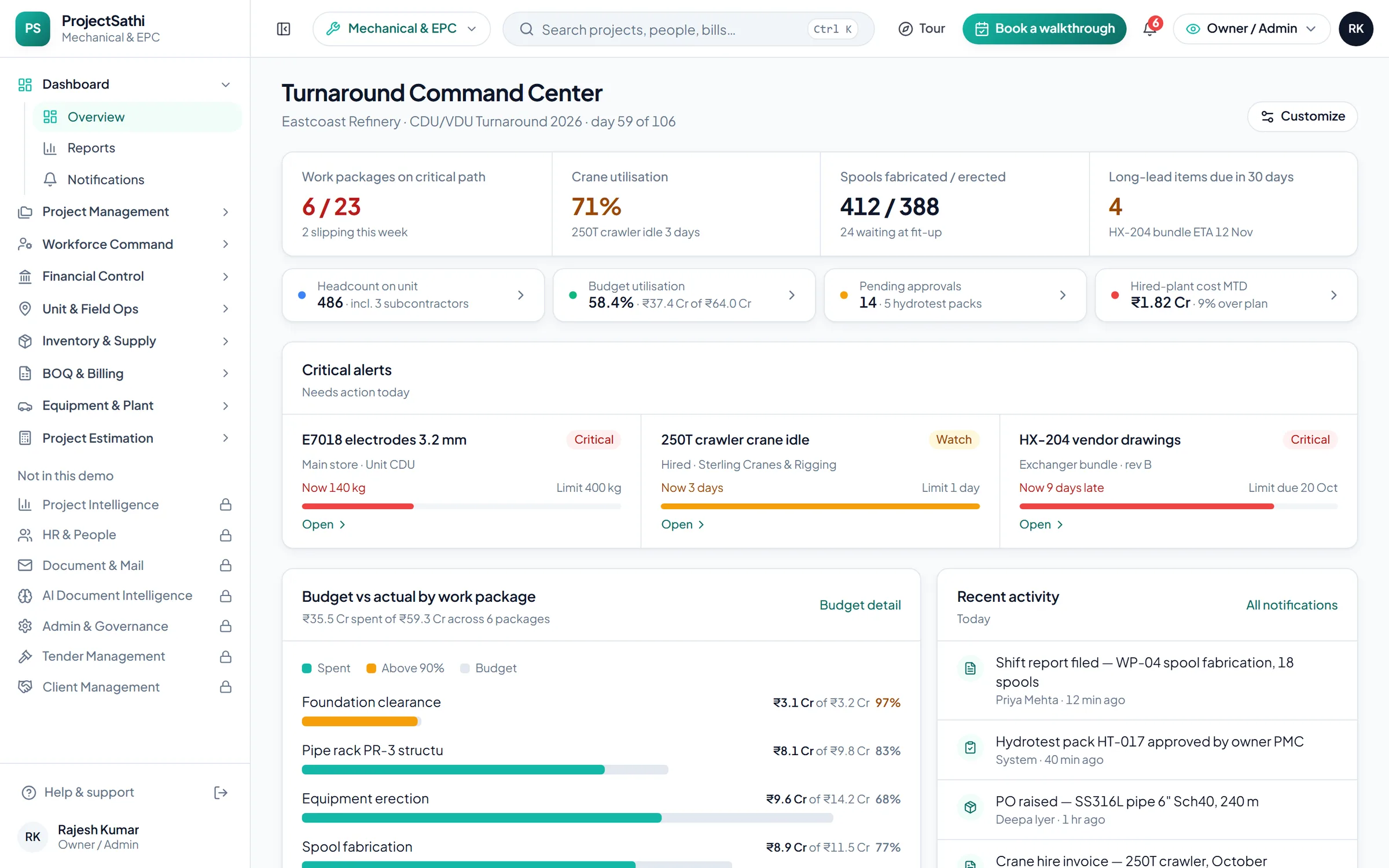
Project management software for EPC companies: work packages on one critical path, long-lead items, hired plant, shift reports and progress bills.
Project management software for EPC companies has to do one thing a general construction tool does not: hold engineering, procurement and construction on a single critical path, so that a late vendor drawing, a long-lead valve stuck at port and a crane booked for the wrong week all show up as the same schedule risk. If the software cannot connect a procurement delay to an erection date, it is a task list, not an EPC tool.
This guide is for mechanical and EPC firms in India running plant shutdowns and turnarounds, fabrication and erection, or piping work for an owner and a PMC. It covers the six capabilities that matter most: work packages, the critical path, long-lead items, hired plant, shift reporting and progress bills, plus the workforce and payroll layer underneath them, and how to evaluate a product against them.
Work packages, not just tasks
EPC work is organised in work packages: a unit, a system, a line or a block of spools, each with its own drawings, materials, crew and acceptance test. The software needs to carry the package as the unit of planning, progress and billing, with tasks underneath it, and let you group packages by unit, zone or discipline.
In ProjectSathi's Project Management module, a project is broken into tasks with dependencies, sequenced on a Gantt with critical-path highlighting and milestone markers, and budget-monitored against the BOQ (bill of quantities) at project, sub-head and item level. For a mechanical team the vocabulary is work packages and spools erected; the demo's turnaround workspace opens with work packages on the critical path, spools fabricated against spools erected and crane utilisation as the morning numbers.
One critical path across E, P and C
The critical path on a turnaround is short and unforgiving. A 30-day shutdown window with interlocking packages means a two-day slip on a single hydrotest can push the restart. The software must:
- Show the critical path explicitly and update it as actual progress is logged
- Let a planner drag a task and see which downstream packages move
- Carry dependencies across disciplines, so a civil foundation release gates a structural erection and a piping fit-up
- Flag delay risk per package before the weekly review, not at it
A civil equivalent is chainage progress by layer on a highway package; an EPC equivalent is spools fabricated, fit-up, welding and hydrotest per line. Both are the same Gantt with different labels.
Long-lead items
Nothing hurts an EPC schedule like a long-lead item: a compressor, a heat exchanger, a control valve with a sixteen-week delivery, an imported instrument held at customs. The software should track these as material with a due date tied to the erection task, with an alert window ahead of the date.
ProjectSathi's Inventory & Supply module carries stock per location with consumption velocity, material requests from the field with approval and issue, threshold-based reorder alerts and a vendor master with lead-time tracking. The mechanical dashboard in the demo shows long-lead items due in 30 days as a headline figure for this reason. The chemical and process workspace adds instruments received against the BOQ and vendor documents awaiting review.
Hired plant and cranes
On a turnaround, hired cranes, hydras and manlifts can be the largest controllable cost after workforce. Hired-plant cost this month is a headline number on the demo's turnaround dashboard, alongside crane utilisation. The platform should hold a master record per machine with its contract and hire agreement, log hours and movement by project and unit, and roll cost up per package so idle hire is visible in the week it happens rather than at the invoice.
ProjectSathi's Fleet & Mobility module does this with vehicle and plant records, fuel logs with photos of the bill, movement tracking, maintenance history, contracts with renewal calendars and compliance reminders for PUC, fitness, insurance and permits.
Shift reports from the unit
EPC field reporting runs by shift, not by day. A fitter and welder crew on nights needs to log headcount, work done, blockers, permits and photos from a phone that may have no signal inside a unit. Site Management on ProjectSathi captures daily logs, inspection checklists with pass or fail items and corrective actions, weather logs and geo-stamped photos from the mobile app, offline-first, syncing when connected. The same inspection checklist pattern covers fit-up and weld visual checks or a pre-commissioning walkdown.
Progress bills to the owner and the PMC
EPC billing is a progress bill against the contract's BOQ or milestone schedule, certified by the PMC, with retention, advance recovery and GST on works contracts. The software must carry the BOQ item by item with rate analysis, record measured quantities, generate the cumulative progress bill with deductions, split CGST and SGST or IGST by place of supply and export to the accountant.
The BOQ & Billing module handles this on ProjectSathi: BOQ import from Excel with sections and versions, rate analysis by material, labour, machinery and overheads, certified progress (RA) bills, ad-hoc invoices and debit notes on one workflow, payment milestones with ageing per client, and GST handling with HSN-coded line items and GSTR export. On Growth and Enterprise plans the result exports to Tally or Zoho.
Workforce and payroll underneath it all
A turnaround can put several hundred fitters, welders, riggers and helpers on one unit for six weeks, many of them through subcontractors, all of them subject to PF, ESI and contract-labour rules. The demo's mechanical workspace shows headcount on unit as a headline figure.
This is where Workforce Command sits: headcount across projects, a CFO view of fully loaded people cost per project and legal entity, a risk engine that flags overruns and under-utilisation, payroll-risk scenarios for cycle changes and statutory rate updates, cost forecasts from confirmed allocations, and one-click reallocation of people between projects that cascades to costing and payroll. The payroll run itself, with PF, ESI, PT and TDS, payslips and the NEFT bulk file, lives in Financial Control. Both are on Growth and Enterprise plans.
Governance for multi-entity EPC firms
EPC contractors often operate across states and entities, with owner audits and PMC document reviews as routine, so project management software for EPC companies has to satisfy the auditor as well as the planner. The Enterprise plan adds multi-entity and multi-state operation, SSO with a full audit trail, approval workflows for sensitive actions such as rate changes and contract awards, activity and login logs, custom reports and dashboards, full API access, a dedicated customer success manager and a security review with a data processing agreement. AI Document Intelligence on Enterprise lets a team ask plain-English questions of the contract, drawings and letters and get source-cited answers.
Evaluating project management software for EPC companies
Take one live package to every demo and ask the vendor to show:
- The package on a Gantt with the critical path, and what moves when you slip one task
- A long-lead item with a due date tied to an erection task, and the alert ahead of it
- A hired crane's cost rolled up to the package for the month
- A shift report entered offline on a phone, then synced
- A progress bill generated from measured quantities with retention, advance recovery and GST
- The payroll run for the unit's headcount, with the NEFT file
- Who sees what: the PMC's view, the project manager's view, the fitter supervisor's view
The ProjectSathi demo runs on sample data for a refinery turnaround; pick Mechanical & EPC and the type of work, and the workspace, labels and tour change to match. The EPC project management software page covers the module set in more detail.
When you are ready to see the platform set up on one of your own packages, with your BOQ and crew loaded, schedule a demo and we will go through it with your planning and billing teams.
Frequently asked questions
What should project management software for EPC companies include that general construction software does not?
Work packages as the unit of planning and billing, a critical path that spans engineering, procurement and construction, long-lead item tracking tied to erection dates, hired-plant cost per package, shift-based field reporting and progress bills certified by a PMC. General tools often cover tasks and daily logs but not the procurement and plant links.
Can it handle a plant shutdown or turnaround?
Yes, if it supports compressed, interlocking work on a live plant: a short critical path updated from shift reports, crane and hired-plant utilisation, headcount on the unit and pending approvals. ProjectSathi's mechanical workspace is set up for shutdowns and turnarounds, fabrication and erection, and piping.
How does billing work for EPC contracts?
As a cumulative progress bill against the contract's BOQ or milestone schedule, certified by the owner's PMC, with retention, advance recovery, TDS and GST on works contracts. The software should generate the bill from measured quantities and export it to the accounting system.
Which plan do EPC firms usually need?
Growth covers billing, payroll, fleet and inventory for up to 15 projects and 200 users. Multi-entity or multi-state firms, or those needing SSO, full API access and AI document search, need Enterprise, which has unlimited projects and users.