Construction ERP vs Project Management Software: Which First?
Construction ERP vs project management software: what each covers, where they overlap, how firms combine them with Tally and which to buy first.
A construction ERP is a company-wide system: general ledger, procurement, HR, fixed assets and multi-entity accounting, with projects as one module among many. Construction project management software is a project-first system: planning, daily field execution, measurement, BOQ-based billing, workforce and materials per project, with the ledger left to an accounting package. The ERP answers "how is the company doing"; the project platform answers "how is each project doing, today".
The construction ERP vs project management software question matters because most Indian contractors and EPC firms already own one half of the answer, usually Tally, and are deciding what to put on top of it. This guide sets out what each system covers, where they overlap, the three ways firms combine them, and a simple rule for which to buy first.
What a construction ERP covers
An ERP is built outward from the general ledger. In a construction context it typically includes:
- Financial accounting across entities, branches and states, with consolidation
- Company-wide procurement: purchase requisitions, orders, goods receipt, vendor payables
- Fixed asset register and depreciation
- Human resources and statutory payroll
- Project costing as cost centres against which transactions are posted
- Management reporting on the whole business
Its strength is a single set of books. Its weakness, on projects, is that it records transactions after they have happened. The daily log, the measurement against a BOQ item, the inspection, the photo and the letter are not ledger events, so the ERP either does not capture them or captures them thinly through a bolt-on.
What construction project management software covers
A project platform is built outward from the workfront:
- Project planning with tasks or work packages, dependencies and a critical path
- Daily progress reports, attendance, inspections and photos from a mobile app
- The BOQ item by item, rate analysis and measured quantities
- Progress bills (RA bills) generated from measurements, with GST and deductions
- Material requests, stock per location, reorder alerts and vendor records
- Vehicle and plant cost per project
- Inward and outward letters, EOT requests and change orders
- Cross-project registers and an owner dashboard
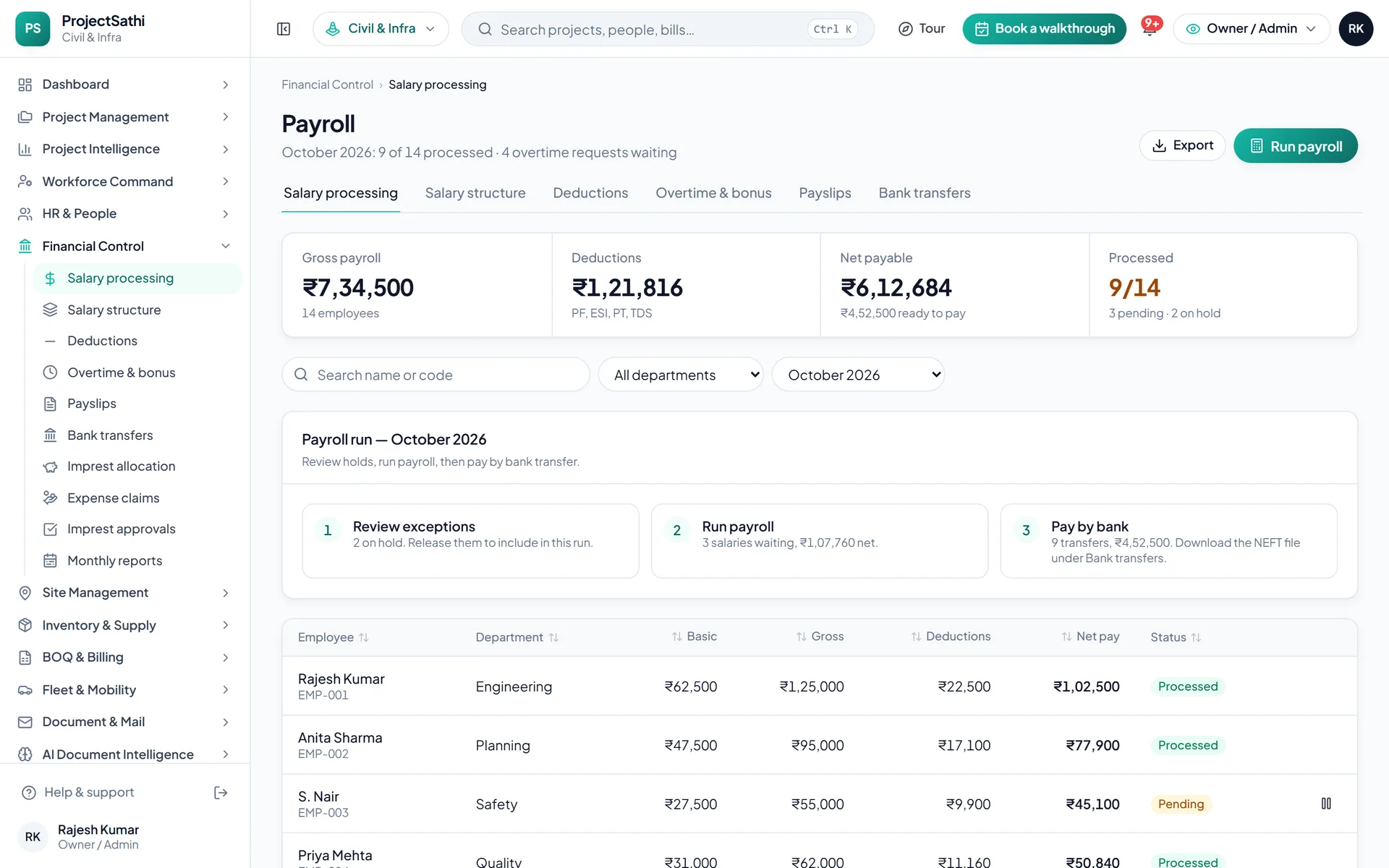
In ProjectSathi, the finance-facing part of this lives in Financial Control: payroll with PF, ESI, PT and TDS, payslips, the NEFT bulk-transfer file, imprest allocation to field engineers and expense claims against it. The billing part lives in BOQ & Billing. Neither replaces the ledger; both produce documents that the ledger books.
Construction ERP vs project management software: where they overlap
The overlap is real and causes most of the confusion:
- Payroll. Both can run it. A project platform runs it from field attendance; an ERP runs it from an HR master. A firm with field workforce on several projects usually wants attendance-driven payroll, then posts the result to the ERP or Tally.
- Procurement and inventory. An ERP handles purchase orders and payables across the company. A project platform handles the request-to-issue cycle on each project and stock per location. ProjectSathi's Inventory & Supply module covers material requests, stock monitoring, reorder alerts, vendor records and stock-takes; purchase accounting stays in the accounting system.
- Cost reporting. An ERP reports cost by cost centre from posted vouchers. A project platform reports BOQ vs actual by item from field entries, before the voucher exists.
What the ERP does not do: critical path, daily logs, measurement books, photo evidence, weather logs, EOT claims, authority correspondence. What the project platform does not do: statutory financial statements, fixed assets, consolidated accounts, GST return filing itself.
Three ways Indian firms combine them
1. Accounting package plus project platform. The most common pattern between ₹10 Cr and ₹200 Cr of turnover. Tally or Zoho Books remains the ledger; the project platform produces the progress bill, the payroll run and the expense claims and exports them. ProjectSathi's Growth and Enterprise plans include Tally and Zoho integration for this reason. The construction ERP for India page describes how the platform plays this role.
2. Full ERP plus project platform. Larger EPC firms with multi-entity accounts often already run an ERP. They add a project platform for field execution, billing and claims, and connect the two through an API or scheduled export. Enterprise plans with full API access exist for this case.
3. ERP with a projects module only. Works where projects are a cost-centre view of a manufacturing or trading business. It rarely satisfies a contractor, because the field and billing workflows are too thin and supervisors will not use an ERP screen on a phone.
A civil example: a ₹60 Cr road contractor keeps Tally for the books, runs daily logs, fleet, BOQ and RA bills on the platform, and posts the certified bill and the monthly payroll to Tally. An industrial example: a mechanical EPC firm on a refinery turnaround already has an ERP for company accounts, and uses the platform for work packages on the critical path, hired-plant cost, long-lead items and the progress bill to the owner.
Which to buy first
The construction ERP vs project management software decision comes down to one rule:
- If your pain is in the field or in billing, buy project management software first. Slow progress bills, unreconciled materials, failed EOT claims and manual attendance are project problems; an ERP will not fix them.
- If your pain is in the books, buy or upgrade the ERP first. Multi-entity consolidation, audit findings on the ledger, and procurement control across branches are company problems; a project platform will not fix them.
- If you have both, start with the project platform on one project while you plan the ERP, because the platform goes live in weeks and the ERP in quarters.
Beware of being sold an ERP because it is "complete". Completeness is only useful if the field team enters data into it, and that depends on the mobile app, offline capture and whether a supervisor can log a day's work in two minutes.
Cost and effort compared
On cost, construction ERP vs project management software is not a like-for-like comparison. In general terms, a construction ERP is a larger commitment: licence, implementation partner, data migration and a project that runs for quarters, with the ongoing cost of maintaining a chart of accounts that matches how projects are run. A project platform is sold as an annual subscription with onboarding included and goes live project by project. ProjectSathi's three plans are quoted after a demo and invoiced quarterly, with a 90-day pilot available on one project.
The right comparison is not licence price against licence price. It is the cost of each system against the problem it is being bought to fix. If the problem is three weeks of billing lag on ₹3 Cr of monthly bills, the working-capital cost alone is the number to beat.
How to evaluate
- Write the two problems you are buying for on one page.
- Ask each vendor to solve those two problems live on your data, not on a slide.
- Ask how the two systems will connect: which documents move, in which direction, how often, and who owns the reconciliation.
- Confirm what the field team will use on a phone, offline, and watch a supervisor try it.
- Run one project for a month before any multi-year commitment.
The ProjectSathi demo lets you do step four yourself on sample data, including running a payroll cycle and downloading the NEFT file, before you speak to anyone.
If you would like to see how ProjectSathi fits beside your Tally or ERP on one of your own projects, schedule a demo and we will walk through the connection with your finance team.
Frequently asked questions
Is construction project management software a replacement for an ERP?
No. It replaces the spreadsheets, WhatsApp groups and point tools between the field and the ledger. The ERP or accounting package remains the system of record for financial statements, fixed assets and GST filing.
Can a project platform run payroll if we already have Tally?
Yes. The platform runs payroll from field attendance, applies PF, ESI, PT and TDS, generates payslips and the NEFT file, and exports the result for Tally to book. Many firms prefer this because the attendance record lives where the field team enters it.
We are an EPC firm with an ERP. Do we still need project software?
Usually yes, if the ERP does not give you work packages on a critical path, daily shift reports, hired-plant cost per unit, long-lead item tracking and progress bills to the owner and PMC. The two connect through an export or API; Enterprise plans include full API access for this.
Which should a ₹20 Cr contractor buy first?
Almost always the project platform. At that size the books are manageable in Tally and the losses are in billing lag, material leakage and weak claims, which are project problems. Start on one project, move billing in the second month, and keep Tally as the ledger.