Best Construction Management Software in India: A Fair Comparison
The best construction management software in India depends on your contracts. A fair comparison of global platforms, Indian apps, Zoho, Tally and Excel.
There is no single best construction management software in India. There is a best fit for your contract type, project count, field conditions and finance setup. A ₹30 Cr road contractor billing NHAI on RA bills, a mechanical EPC firm running a refinery turnaround and a ten-person builder with two residential projects will each choose differently, and all three can be right.
This guide compares the five categories of tools that engineering and project teams in India actually use: global platforms, Indian construction apps, generic project and business suites, accounting software, and spreadsheets with WhatsApp. It describes each fairly, says where ProjectSathi (our product) fits, and ends with a checklist you can score any vendor against.
The best construction management software in India, by category
1. Global construction platforms
Products such as Procore and Buildertrend are mature, well-documented and strong on document control, RFIs, submittals and owner reporting. They are built around North American contracting practice, priced in dollars, and assume a separate accounting and payroll stack.
Where they fit: large firms with international clients, a dedicated project-controls team and the budget to configure them.
Where they struggle in India: BOQ-based measurement and cumulative progress bills are not native workflows; GST on works contracts, TDS and labour-cess deductions need workarounds; PF and ESI compliance lives elsewhere; and support hours and pricing are set for other markets. The Procore alternative for India page goes deeper on these differences.
2. Indian construction apps
A newer group of products, Powerplay among them, started from the Indian field problem: attendance, daily progress reports, material tracking and simple expense capture from a phone. They are quick to adopt, familiar to supervisors and priced for small teams.
Where they fit: contractors with a handful of projects whose first pain is field visibility.
Where they struggle: as the firm grows, the gaps appear in contract-grade billing, statutory payroll, correspondence and EOT records, multi-project rollups and audit trails. Many firms outgrow them around the sixth or seventh concurrent project and end up adding spreadsheets back. See the Powerplay alternative page for a module-by-module view.
3. Generic project and business suites
Zoho, Microsoft Project and similar suites offer tasks, Gantt charts, CRM, books and HR as a family of apps. They are flexible, inexpensive per user and integrate with each other.
Where they fit: consultancies, PMCs and design offices whose deliverables are documents and milestones rather than measured quantities.
Where they struggle: nothing in a generic suite understands a BOQ item, a measurement book, a secured advance or a retention deduction. You can model these with custom fields, but you are then building and maintaining your own construction system on top of a general tool. The Zoho alternative for construction page sets this out.
4. Accounting software
Tally, and increasingly Zoho Books and Busy, are where most Indian contractors' money already lives. GST returns, ledgers, vouchers and the auditor's working papers depend on them, and no project platform should try to replace that.
Where they fit: every firm, as the system of record for the ledger.
Where they struggle: accounting software records what was invoiced and paid, not what was executed. The progress bill is built outside it and keyed in afterward, which is where the reconciliation errors come from. The right model is a project platform upstream that exports to Tally or Zoho, which is how ProjectSathi's Growth and Enterprise plans are set up. See construction software vs Tally.
5. Spreadsheets and WhatsApp
Excel for the BOQ, schedule and bill; WhatsApp groups for daily photos, attendance and instructions. Free, universal and surprisingly far-reaching.
Where they fit: one to three projects with a strong project manager who can hold it all in their head.
Where they struggle: nothing connects. The same quantity is typed three times, the photo evidence for an EOT claim is scattered across chats, and the owner's view is whatever was compiled last Friday. The comparison of WhatsApp groups and construction project software is the honest version of this trade-off.
Where ProjectSathi fits
ProjectSathi, by Aryavrut, is our product, so read this section with that in mind. It is a project management platform for engineering and industrial projects in India, with sixteen engineering modules that cover planning, field execution, BOQ and billing, workforce and payroll, inventory, fleet, correspondence, tenders and estimation, and a studio edition for architecture and interiors.
Three things distinguish it from the categories above:
- Billing and compliance are native. Item-level BOQ, rate analysis, certified progress (RA) bills with GST split correctly, payroll with PF, ESI, PT and TDS, and a Tally or Zoho export, all on the same platform as the daily log.
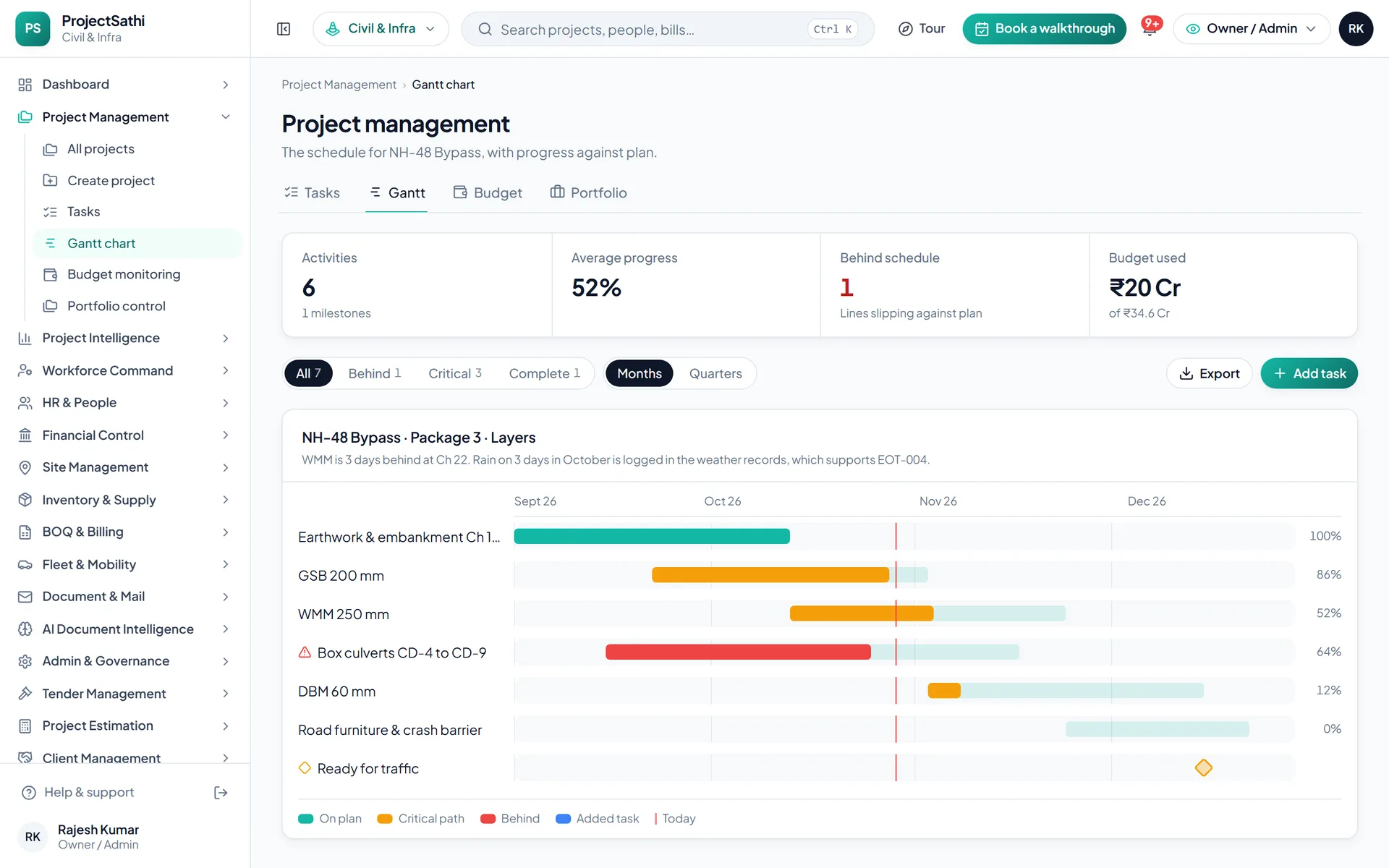
- It is industry-aware, not civil-only. The same modules run a road package, a refinery turnaround, a chemical unit expansion or a solar park, with the vocabulary changed. The Project Management module carries the Gantt, critical path and BOQ vs actual in every case.
- It is sold as an annual contract with onboarding included, in three plans (Starter, Growth and Enterprise), invoiced quarterly and quoted after a demo, with a 90-day pilot on one project for first-time adopters.
It is not the best construction management software in India for everyone. A two-project firm may be better served by a lighter app for the first year, and a firm whose main need is international document control may prefer a global platform. The module pages under features show exactly what is and is not there, plan by plan.
How to choose: a scoring checklist
Score each shortlisted product from 0 to 3 on every line. Weight the lines that match your contracts.
Contract and billing
- Carries the BOQ item by item with sections, sub-heads and version history
- Generates cumulative progress bills with deductions, not just invoices
- Handles GST on works contracts: CGST/SGST or IGST, HSN/SAC codes, GSTR export
- Tracks payment milestones, ageing and retention per client
Field execution
- Mobile app works offline and syncs cleanly
- Daily progress report with workforce, materials, work done, blockers and photos
- Geo-stamped photos and weather logs usable as EOT evidence
- Inspection checklists with corrective actions
People and compliance
- Attendance feeds payroll without re-entry
- PF, ESI, PT and TDS computed per employee; NEFT file for bank transfer
- Role-based permissions by module, project and field
- Full audit trail of who changed what
Materials and equipment
- Stock per location, material requests with approval, reorder alerts
- Vendor records with lead time and payment history
- Vehicle and plant cost per project, fuel logs, compliance reminders
Control and reporting
- Owner dashboard across all projects, role-aware
- Cross-project view of bills, EOTs, change orders and letters
- Export to Excel and PDF from every register
Commercial
- A written quote in rupees, with plan limits stated
- Onboarding included, with a named timeline
- Support in your working hours, on WhatsApp if that is how your team works
- A low-commitment pilot before the annual contract
A product that scores high on field execution and low on billing is an app; high on billing and low on field is an accounting add-on; high on both is a platform. Decide which you are buying before comparing prices.
A practical evaluation path
The best construction management software in India for your firm is the one that survives a real bill and a month of field entry. To find it:
- Shortlist one product from each of two categories, not five from one.
- Take one live project and one real progress bill to every demo.
- Try the product on sample data yourself before the sales call. The ProjectSathi demo lets you pick your industry and modules and approve a bill, raise a material request and run payroll in about fifteen minutes.
- Ask for the onboarding plan in writing, with who does the data setup.
- Run a pilot on one project before you sign for the year.
If you would like to see ProjectSathi set up on one of your own projects, with your BOQ and your team, schedule a demo and we will go through it with you.
Frequently asked questions
Which is the best construction management software in India for a small contractor?
For one to three projects, the deciding factor is adoption by field supervisors, so a mobile-first app with attendance and daily reports is a reasonable start. If progress billing and payroll are already painful, a platform with those built in avoids a second migration a year later. A clear written quote and a pilot option matter more than feature counts at this size.
Can I keep Tally and still use a construction platform?
Yes, and you should. Accounting software stays the ledger of record. The platform produces the certified progress bill, the payroll run and the expense claims, and exports them to Tally or Zoho so the accountant books them once instead of rebuilding them.
Are global platforms like Procore suitable for Indian contracts?
They can be, for large firms with international clients and a project-controls team. For BOQ-measured contracts with GST, TDS and labour-cess deductions, PF and ESI compliance and authority correspondence, most Indian firms find the workarounds outweigh the benefits.
How much should I budget?
Annual contracts for a platform that covers field, billing and payroll typically run in the lakhs per year for a mid-size firm. ProjectSathi quotes its annual plans after a demo, with onboarding included; lighter apps cost less and global platforms generally cost more once configured.